TTC Service Changes Effective February 8, 2026

The TTC has not yet issued its detailed memo listing the operating designs for bus service changes effective February 8, 2026. When it is available, I will update this article with all of the usual information including a spreadsheet with before-and-after service comparisons. Information in this preliminary article is culled from a presentation at the TTC Board meeting of February 3, various TTC web pages, and the GTFS version of schedules (electronic versions used by trip planning apps).

Note that in addition to Line 5 related changes, there are also updates to:

  • 31 Greenwood
  • 384 Sheppard West Night Bus
  • 149 Etobicoke-Bloor
  • 830 Henry Kelsey–Middlefield (new school service)

These are described at the end of the article.

Continue reading

How Fast Will Line 5 Be Compared to the 32/34 Bus?

With the imminent opening of Line 5 Eglinton LRT on February 8, the TTC has repeatedly been asked “will it be faster than the bus”. They have said, yes, but with few details.

On February 3, the online schedules (GTFS format) came out for the next period including stop-by-stop travel times for Line 5. This article compares these times with the existing schedules for the 32 Eglinton West and 34 Eglinton East buses. The LRT is almost always faster except late in the evening, and then on only part of the route.

Later in the article are charts of scheduled speeds and stop spacing for the bus and LRT operations.

Continue reading

TTC Board Meeting: February 3, 2026

The TTC Board will meet on Tuesday, February 3, 2026 at 9:30am in North York Council Chamber. The agenda is rather thin, and there are several confidential issues that will trigger an in camera session. There is no formal item regarding Line 5 Eglinton, although one never knows what might come up in debate.

Of interest are the following items:

Updated February 2 at 10:10am: Slide decks for the invited presentations have been posted on the TTC site. Links to them are added below.

  • CEO’s Report
  • Invited presentations from:
    • Narayan Donaldson on “Opportunities to improve Transit Signal Priority in Toronto”. According to the covering report “This presentation will discuss the strengths and weaknesses of the Transit Signal Priority (TSP) system used on Toronto’s streetcar, bus and LRT systems, compare it to a TSP system commonly used in the Netherlands, and suggest areas of improvement.”
    • Jonathan English on “Developing a Surface Transit Revitalization Plan” According to the covering report “This presentation will discuss steps that can be taken to improve speed and reliability of the streetcar network, as well as new LRT lines.”

After the meeting, I will write up the presentations in an update to this article.

Continue reading

Twenty

January 31, 2026 marks the 20th anniversary of this blog. Over the years, we have covered a lot of territory in transit discussions. I say “we” not as the royal plural, but to recognize the contributions of reader comments, and the many conversations I have had via social media or in person that collectively expanded my views.

The stats for the past year:

  • About 120 articles pushing the total to 3,118
  • About 1,300 comments pushing the total to 62,279

Yes, I’ve slowed down a bit, but as regular readers will know, some of the articles have grown longer and take more background work to prepare.

Those 1,300 comments do not include the bilge from various trolls who I suspect to be only a handful of people with their hobby horses, a very recognizable style, albeit many pseudonyms. I have an archive of their words but do not burden readers, most of the time, with what passes for “comment”.

Frankly, it is the wide range of comments, favourable or not, but civilized in tone that makes editing and publishing them worthwhile.

The community of “transit advocates” has certainly grown. We don’t all agree all of the time, and that’s natural, but we share a desire to see Toronto better served by transit.

Twenty years saw many changes, arrivals and departures, sadly more of the latter. Within the transit “fan” community we lost some of the original Streetcars for Toronto Committee members, and others whose photos and movies still grace various sites.

I don’t seek or collect accolades, but was pleased to receive an “Excellence Award” from the Canadian Urban Transit Association in late 2024 recognizing decades of advocacy including this blog. A real treat was the Jane Jacobs Prize back in 2005, the last year she was alive to bestow it in person. That actually happened before the blog started, but was part of the inspiration to write for an online audience. Kind words have come from others for which many thanks. You know who you are.

I went back to my first anniversary article to see what might have changed, and found this concluding paragraph.

The next years will be vital for transit in our city and region. Either we stop pretending that we can be transit oriented without serious investment in operations, vehicles and facilities, a real network of services, not a few baubles to get politicians re-elected, or we will slide into the car-oriented city that “Stop Spadina” and its era were supposed to prevent.

Continue reading

6 Finch LRT Delay Data for December 2025

The TTC has now added 6 Finch to the collection of published delay data available on the City of Toronto’s Open Data site. See:

The data are in a summary format, much less detailed than the version on which I based a recent article, but they have the advantage of being in spreadsheet format that makes general analysis easier.

In the form published by the TTC, the data include:

  • Date and time of the event
  • Location
  • Event Code
  • Minutes of delay and gap
  • Direction
  • Vehicle number
  • List of event codes

For the purpose of this article, I sorted and summarized the events by code and by the number of times it was reported. (If you want to see the full unedited list, download the file from the City’s site.)

What is immediately obvious here is that the majority of the delays are due to equipment and infrastructure failures, and that a few individual events caused extended outages. These are numbers as reported by the TTC, and do not really show the degree to which 6 Finch was effectively unavailable to riders who had to use shuttle buses instead.

Overall, in the period from December 7-31 there were 350 events.

Updated January 21, 2026 at 10:40pm:

By comparison, the streetcar network, with many longer routes in a more challenging operating environment, had only 819 events between them. Of these, 22 were infrastructure issues (with only 2 switch issues), 74 were due to equipment issues and 113 to diversions. Common incidents were due, broadly speaking, to passenger issues: 102 ill patrons, 106 unsanitary cars, and 169 security issues (most commonly “disorderly patron”).

501 Queen160509 Harbourfront23
504 King166510 Spadina75
505 Dundas124511 Bathurst59
506 Carlton115512 St. Clair69
507 Long Branch28

More Money For CanCon, Not For More Trains

Today, Ontario announced that it would raise the Canadian content in 55 new Line 2 trains from roughly 25 to 50 percent. The provincial capital subsidy for this purchase will rise from $758-million to $950-million, and the increase will be matched by the federal government who are also funding this purchase. There is no change in the Toronto share.

It is not clear whether the federal contribution is net new money, or merely a reallocation within Toronto’s share of the ten-year transit funding program.

Updated January 16, 2026: According to the federal government announcement, the funding will come from an existing allocation stream and is not net new money.

This project is part of the previously announced 10-year funding commitment under the Baseline stream of the Canada Public Transit Fund (CPTF). Beginning in April 2026, the Toronto Transit Commission will receive up to $1.2 billion in CPTF funding over 10 years from 2026 to 2036. 

A related question is which government(s) will be on the hook for the extra CanCon in future transit vehicles including those for the Scarborough and Richmond Hill extensions, and for added capacity to deal with expected growth. Collectively these account for a potential 57 more trains, doubling the size of the eventual order.

What the announcement did not address is a list of questions about the Toronto subway fleet overall:

  • When will the cars be delivered, and how much work is needed to keep the old Line 2 trains operating in the interim?
  • When will Metrolinx place the add-on orders to provide trains for the Line 2 Scarborough and Line 1 Richmond Hill extensions?
  • How will delivery of the add-on trains affect opening dates for the extensions?
  • Will complete replacement of Line 2 trains be delayed because new trains are needed to provide service on these extensions?
  • Will the extensions have enough trains to provide full service to the new terminals, or will some trains have to short-turn in peak periods?
  • How soon does the TTC project it will require more trains to improve capacity on Lines 1 and 2, and how will these be funded?
  • What is the status of funding and timing for new maintenance facilities on Lines 1 and 2 to hold and service the additional trains?
  • Will the Automatic Train Control (ATC) technology for Line 2 be the same as the existing system on Line 1, or will the two lines (and their fleets) be limited to use only their “own” trains?

The TTC produces a quarterly report on all its major capital projects with the intent of showing all planned work, but it does not produce a unified chart or timetable showing how everything fits together and where critical links might be in the overall plan. The TTC has a “Strategic Planning Committee”, and this is a complex piece of strategy that badly needs detailed, public review.

Continue reading

Service Recovery Update: January 2026

When the TTC talks about service levels, a common comparison is to the pre-pandemic period. I have reviewed this issue before:

This article presents an update on previous reviews to service levels in January 2026 comparing it both with January 2020, and with November 2024 to show what has changed over the past year. Also reviewed is the evolution of travel times on major routes to show the effect of congestion-related schedule changes from 2020 to 2026.

All headway and travel time data here come from the TTC’s Scheduled Service Summaries. An archive of these files is available on this site here.

The usual citation is the number of vehicle and train hours operated today versus the “before times”. Here are the raw numbers:

Planned Weekly HoursRegular ServiceConstructionTotal
January 2020185,8257,068192,893
January 2026193,6625,234198,896

These values can be misleading because the 2026 and 2020 networks are not the same. Moreover, one vehicle hour does not provide as much service to riders today because of slower operation and increased recovery times in the schedules.

From a rider’s point of view what matters is the headway, the time between vehicles.

Although many routes have more frequent service today than in 2020, this is not universal. Riders do not travel on “average” routes, but on those needed for each trip. Their experience could reflect a decline in scheduled service on their routes. This is compounded by reliability and the perennial problems of bunching and gapping.

The table below compares January 2020 with January 2026 weekday headways. Five schedule periods are shown in the major groups reading across. Within these are the 2026 and 2020 headways, the percentage change, and the change in wait time.

Where the 2026 and 2020 times are unchanged, the cells are blank to avoid clutter. Otherwise, the 2026 headways are colour coded:

  • Green: Improved
  • Pink: Reduced
  • Blue: New service
  • Red: Service discontinued

There is a lot of pink in these charts indicating that many routes are less frequent today than six years ago.

Note that in January 2020, 503 Kingston Road and 505 Dundas operated with buses, and headways then reflected the lower capacity of those vehicles.

Continue reading

Will Line 5 Eglinton Open In February?

The TTC has posted an internal notice that the operators’ sign-up for work in the period starting February 8, 2026 has been delayed because of the complexity of changes happening concurrently on the bus network.

The year 2026 is in the memo giving hope that the line may actually open soon.

Thanks to Gamile Anthony King for posting this on Facebook

TTC Budget Meeting January 7, 2026

The TTC Board considered its Operating and Capital budgets on January 7 before passing them on to the City as part of the overall budget process. For details on these reports see:

Over roughly three hours there was a staff presentation, public deputations and a debate that often avoided major discussion of alternatives and future policy. A key item for future budgets is the shortfall in funding from provincial and federal governments, but also the city’s appetite for continued increases in the municipal subsidy.

Some commentary and claims about the TTC budget have distorted or missed some key items.

  • Yes, the TTC is asking for more subsidy in 2026, but at a level set by the Mayor’s Office before the budget was completed. We have known for some time that this number was $91-million, and the budget options were chosen to hit this target.
  • There is a confusion between actual cuts within the budget and “efficiencies”. The latter implies that there is always waste to be found that can keep subsidy calls down, but in fact barely $10-million falls under that heading for 2026, and there is even less available going forward into 2027.
  • The big reductions lie in accounting changes shifting depreciation costs to the Capital budget, and booking WSIB costs only for the current year rather than accruing future year costs arising from current incidents. There is also an unspecified corporate wide reduction with no indication of what the impact will be. These cannot be repeated in 2027.
  • The budget-to-budget comparison from 2025 to 2026 looks not too bad because 2025 budget was at a higher level than actual results. The gains needed in 2026 are considerably higher measured against the 2025 actuals which are below the budgeted levels.
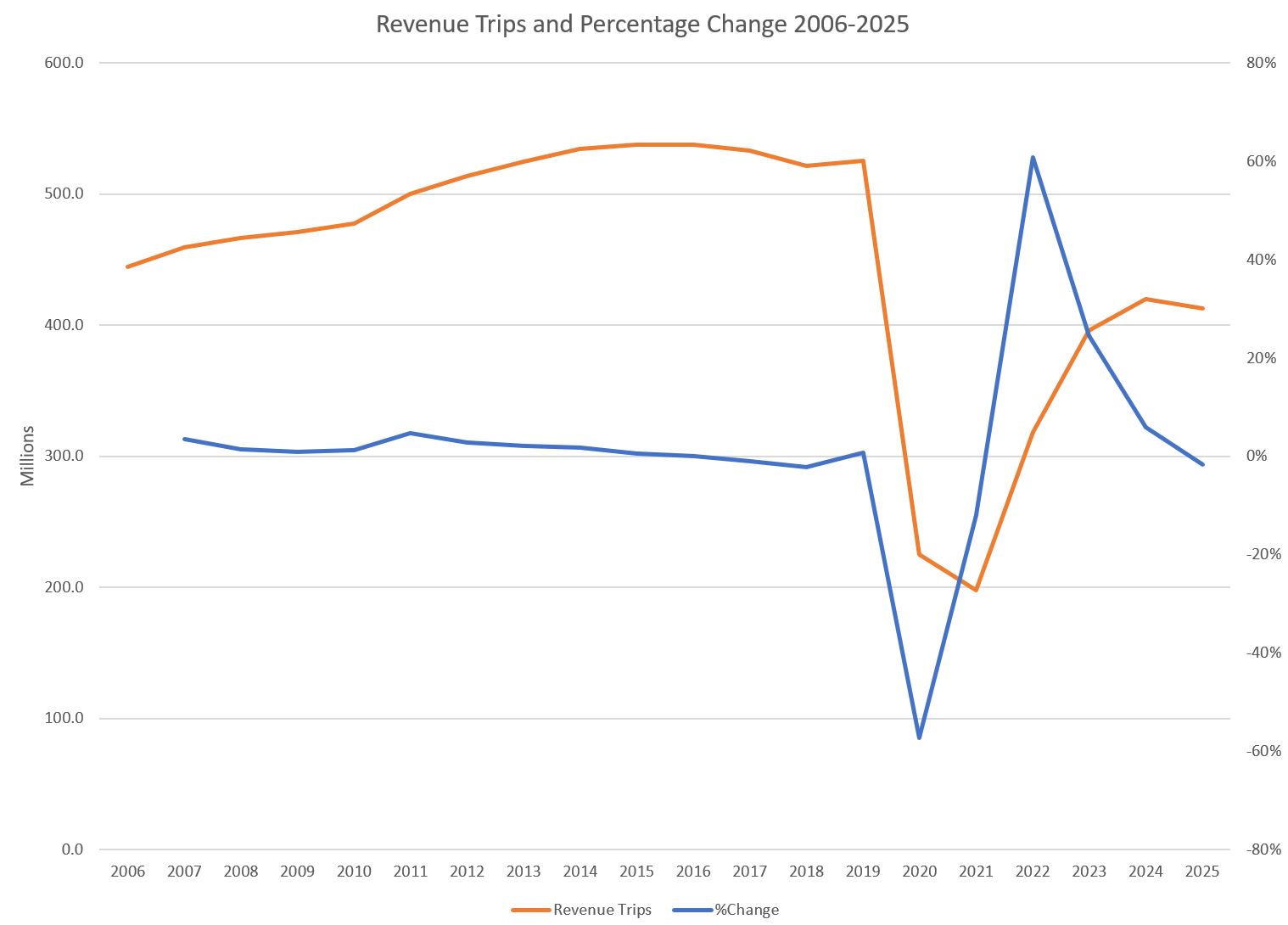
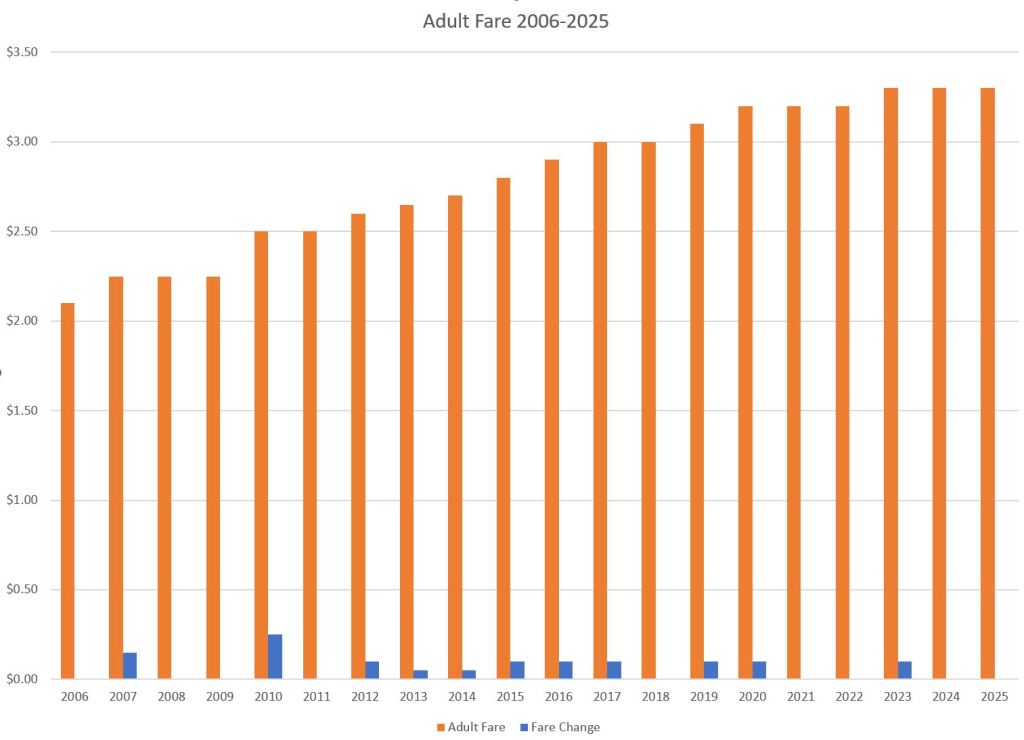
  • Discussion of how to eliminate the operating shortfall through the farebox led to the frightening figure of a $1.90 fare increase. This of course would have a huge effect on affordability and ridership especially if programs to improve service were choked off at the same time. That big number is a direct result of years of fare freezes going back into the Tory era and the fact that ridership is still well below 2019 levels. The gap gets wider and wider, and would be paid for by bigger and bigger fare hikes if that approach were taken.
  • Appeals for better operating funding will inevitably run into claims that other cities have raised fares while Toronto chose to keep its fares low. That is a policy decision by the City. Should additional subsidy be paid to support that from other governments? One problem with numbers cited by management is a mix-and-match of cash fares and regular adult fares in some cities that they cite by comparison to Toronto. For example, the MiWay (Mississauga) cash fare is $4.50, but the adult Presto fare is $3.50, only slightly higher than Toronto’s.
  • Fare enforcement has improved revenue by more than expected, but is hampered by available staffing and operating practices such as all-door loading that would cost money and capacity if they were changed. The Board seems incapable of looking at both sides of the ledger and fixates on revenue, enforcement and limiting opportunities for evasion without considering the effect on service delivery.
  • Claims about service improvements in 2026 muddle what is actually in the budget. The subway service improvements were actually implemented in 2025. All the budget does is make provision for full-year funding of this change (and similarly for other 2025 changes). Subway service is constrained by the size of the Line 1 and 2 fleets, plus the limitations of the signal system on Line 2. Current replacement plans do not add to the fleets, and there is considerable expense to keep Line 2 trains running until the new trains arrive. There is some provision for extra bus and streetcar service, but some of that will disappear to congestion effects, and service improvements will not begin until Fall 2026.
  • Commissioner Saxe proposed that the TTC study the elimination of cash fares. Nothing will come back on this for two budget cycles (i.e. at least 2028) because the report is not due until early 2027 and will likely have no effect on that year’s budget.
  • Chair Myers proposed that the 2027 budget and subsidy consider linking goals and metrics for TTC performance. This is a dangerous idea on a few counts. Most obviously, what targets would the TTC aim at? It is no secret that existing metrics leave a lot to be desired and, in some cases, have been cooked to put management in the best light. The last thing we need is a potential cut in funding to arise from failure to meet targets, or to be based on metrics that do not reflect actual rider experience. In turn, that would encourage creative reporting of results when what is needed is transparency and honesty.
Continue reading

29/929 Dufferin Travel Times to December 2025

This article includes reviews of the 29/929 Dufferin local and express services to the end of 2025. The major item of interest is the introduction of “red lanes” south of Bloor Street and their effect on the bus service. Detailed charts are included here for:

  • November and December travel times in both directions between King and Bloor.
  • January 2024 to December 2025 historical stats on travel times.
  • The segment between Lawrence and Wilson that does not have transit priority, but which has much more congestion than at the south end of the route thanks to Yorkdale Mall.

General observations:

  • The benefit of the red lanes is more pronounced for northbound than for southbound trips, and only at certain times of the day.
  • There is much more severe disruption of service northbound near Yorkdale Mall, but no transit priority measures are proposed there.
  • Headways on Dufferin remain widely scattered near terminals (northbound at King, southbound at Transit Road just outside of Wilson Station).
  • Even on Christmas Day when weather was relatively benign and travel times were lower than normal, headways were not reliable.

Part of the improvement in travel time in December 2025 could be due to seasonal effects. When the data are in for early 2026, we will see how long-lived the saving actually is. I will publish an update to this article in a few months when the pattern is clear.

There are a lot of charts in this article, and I have put them all after the “more” break. Those who are interested in the details can open the full article.

I will turn to a review of 511 Bathurst streetcar and 7 Bathurst bus which both saw recent changes in future articles.

Update: For clarity, the red lanes currently extend only as far north as Dundas. After work up to Bloor is completed in the Spring, I will publish an update showing the effect.

Continue reading